Who Invented Gummies? The History and Industrial Evolution of Gummy Candies

Gummy candies represent a significant category within the global confectionery market, known for their distinct elastic texture and diverse shapes. For wholesale buyers and brand owners developing new product lines, understanding the history and manufacturing evolution of these products provides valuable context for modern sourcing. Addressing the common questions of who invented gummies, when were gummies invented, and where do gummies come from requires examining the transition from early regional sugar confections to modern automated industrial production.
The development of the modern gummy candy is traced to early 20th-century Europe, specifically Germany. However, the foundational techniques of gelling sugar syrups existed long before this specific invention. Today, the industry has expanded far beyond its original scope, incorporating plant-based hydrocolloids, advanced servo-driven depositing technology, and highly specialized climate-controlled curing processes. The sections below outline the origins of gummy candies, their transition from handmade workshops to industrial facilities, and the current global market landscape for wholesale manufacturing.
Precursors: Early Gelled Confections
Before addressing exactly who invented gummies in their modern form, it is helpful to look at the precursors to gelatin-based candies. Humans have manipulated sugar and gelling agents for centuries to create textured sweets.
Turkish Delight (Lokum): Originating in the Middle East, this confection relies on starch and sugar. While it presents a gelled texture, it is softer and less elastic than modern gummies. It demonstrates an early application of starch as a structural binding agent in confectionery.
Before gelatin became the commercial standard, confectioners utilized plant resins and starches to create gelled sweets. Historical records of early jujube confections (Pâte de Jujube) date back to 18th-century Europe, heavily relying on gum arabic (resin from the acacia tree). This formulation was later popularized commercially in the United States by the Henry Heide Candy Company in the early 20th century. Similarly, Wine Gums were formally introduced in the United Kingdom by Charles Gordon Maynard in 1909. According to confectionery science principles, gum arabic produces a notably firm, dense, and slightly waxy texture that takes longer to dissolve in the mouth compared to gelatin. While these early products successfully established a consumer market for textured candies, the specific bouncy, elastic chew associated with modern commercial gummies had not yet been achieved.
Where Do Gummies Come From and Who Invented Them?
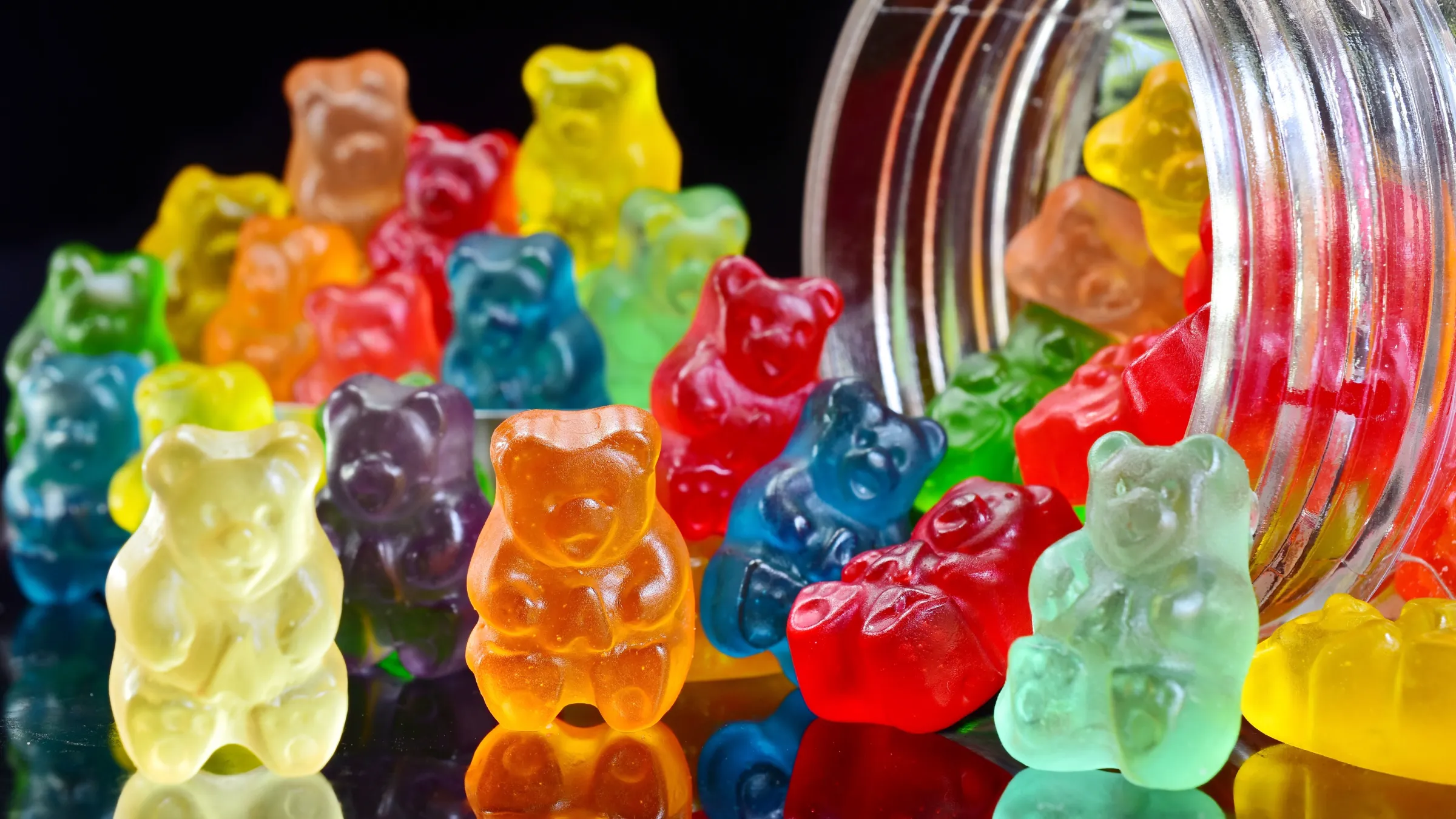
The answer to where do gummies come from is Bonn, Germany. The specific invention of the bear-shaped fruit gum is attributed to Hans Riegel Sr., a confectioner who founded the company Haribo in 1920. Riegel started his business in a small kitchen, initially producing hard candies.
In 1922, Hans Riegel Sr. created a bear-shaped, fruit-flavored confection known as the "Dancing Bear" (Tanzbär), inspired by the trained bears at European street festivals. This creation served as the direct predecessor to the modern HARIBO Goldbear. It successfully propelled the bear-shaped format into a highly recognizable, globally distributed confectionery item, making gummy bears a foundational pillar of commercial production lines today.
From Handmade Workshops to Industrial Production
The transition from Riegel’s early copper kettles to the modern gummy manufacturing facility involves significant advancements in process engineering. Early production relied heavily on manual labor, with workers pouring hot syrup into starch molds by hand.
The Starch Mogul Process
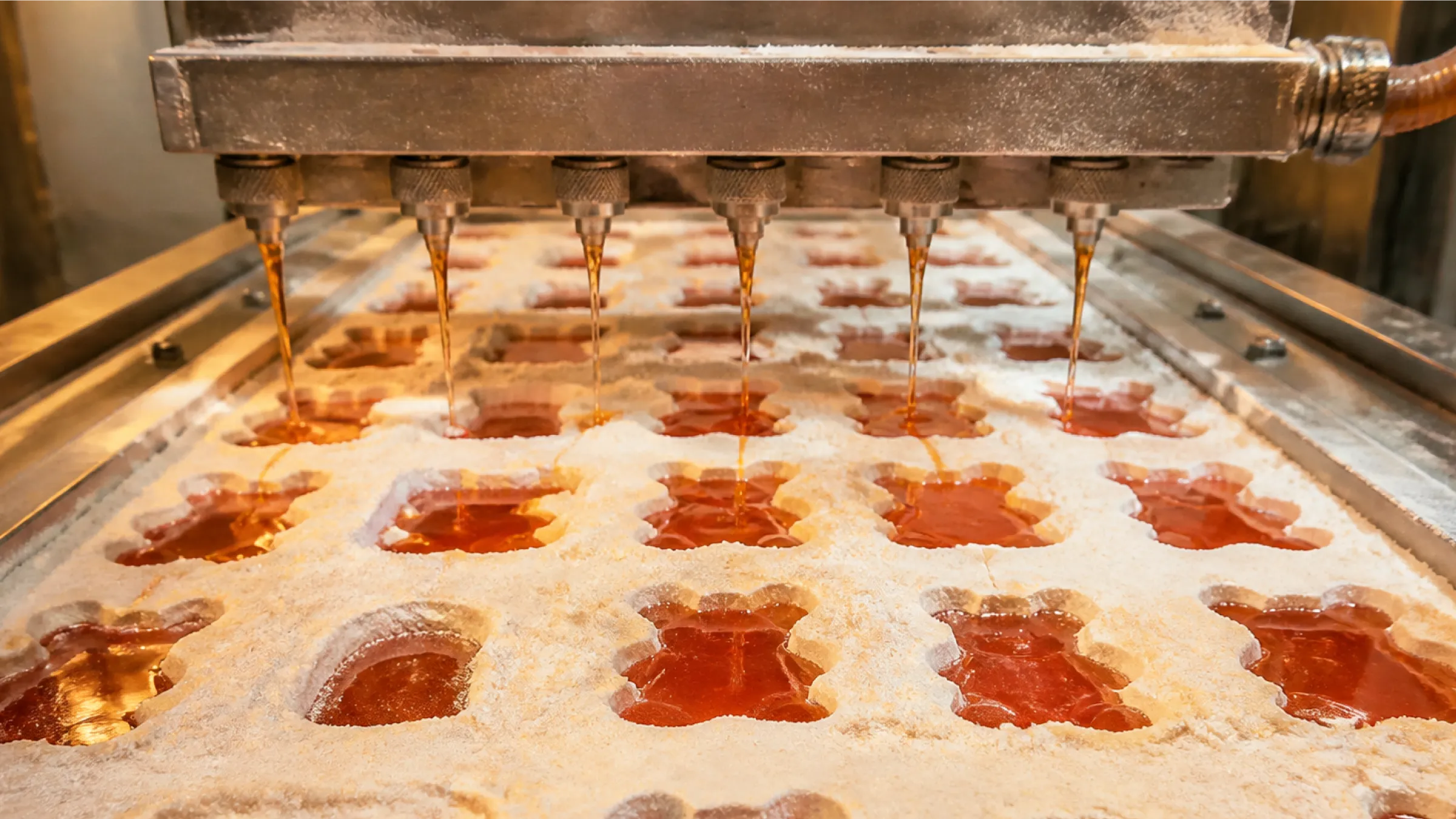
The industrialization of gummy candy was largely driven by the development of the starch mogul machine. In this process, trays are filled with refined cornstarch. A stamping board presses specific shapes into the starch, creating negative cavities. The cooking system then deposits the liquid gummy mass into these cavities. The starch serves two functions: it provides the mold for the shape, and it absorbs excess moisture from the candy during the drying phase.
Modern Automation and Depositing
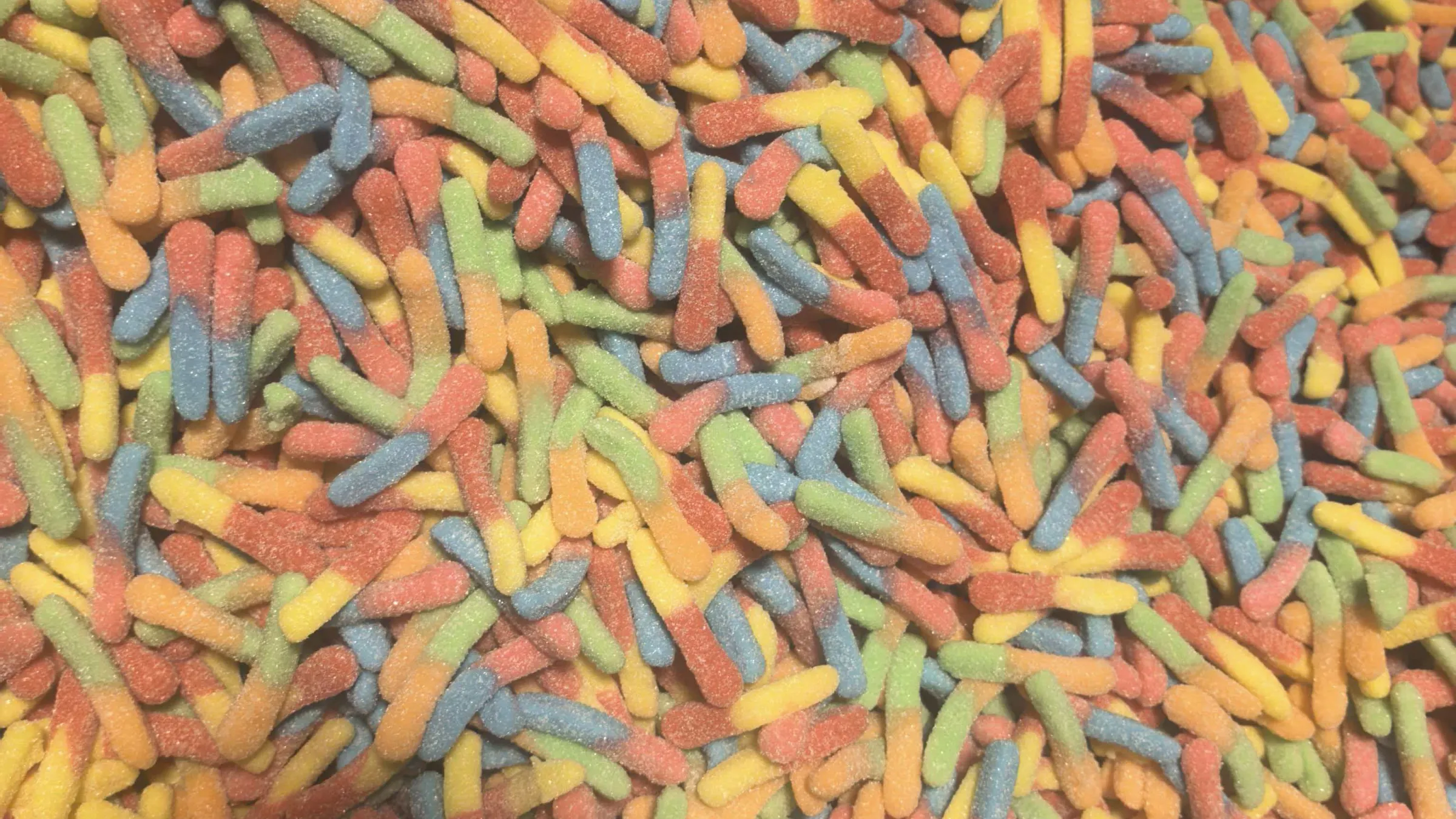
Today, commercial gummy factories utilize highly automated systems. Batch cooking has frequently been replaced by continuous cooking systems that precisely control the dry matter content (Brix) and water activity (Aw) of the syrup. Modern servo-driven depositors ensure that exact gram weights are injected into the molds at high speeds. These advanced nozzles allow for complex products, such as center-filled items or dual-color depositing used to produce segmented shapes like gummy worms.
The Role of Drying Rooms
A critical evolution in gummy manufacturing is the management of the curing phase. After depositing, the trays must be stored in drying rooms. Early facilities relied on ambient conditions, which led to inconsistent product quality depending on the weather. Modern factories utilize sophisticated, climate-controlled drying rooms with specific temperature and humidity parameters. This infrastructure allows manufacturers to accurately calculate curing times, standardize moisture targets, and manage production lead times effectively.
The Evolution of Modern Gummy Categories
Although gelatin eventually established itself as the dominant gelling agent for standard commercial gummy production, the modern market requires a broader range of formulations to meet diverse dietary, functional, and regional requirements.
Shape Diversification
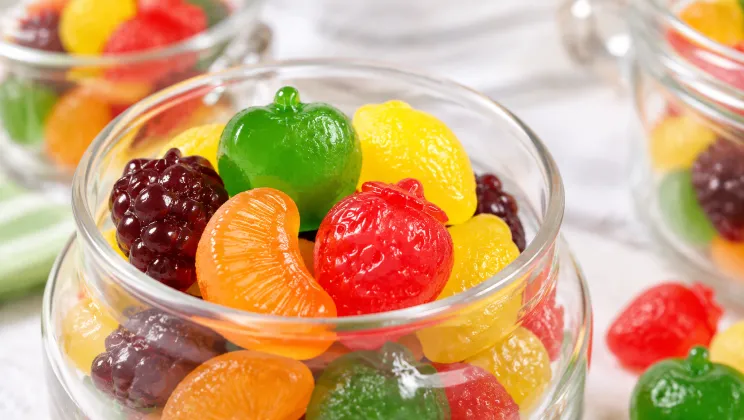
The success of the gummy bear led manufacturers to develop new tooling for an array of shapes. By the 1980s, the market saw the introduction of segmented shapes and extruded products. Today, factories maintain libraries of standard molds, including gummy rings, fruit shapes, and themed designs.
Plant-Based and Vegan Formulations
Because traditional gelatin is animal-derived, the industry developed alternative gelling systems to serve vegan and vegetarian markets. Pectin, extracted from citrus peel or apple pomace, serves as the primary plant-based alternative. Pectin sets through a different chemical mechanism than gelatin, requiring precise pH and Brix control, and it yields a firmer, shorter bite. Carrageenan and agar are also utilized for specific texture profiles. Producing certified vegan gummies requires the manufacturer to verify all ingredients, including colors and glazes, and manage cross-contact risks during production.
Dietary and Religious Certifications
Global distribution requires compliance with specific dietary standards. Halal gummies and kosher variants are formulated using certified bovine gelatin, fish gelatin, or plant-based hydrocolloids. Production of these items depends on the specific certification scope of the manufacturing facility and documented cleaning validations between production runs.
Sugar-Free and Functional Products
The category has expanded to include sugar-free gummies that utilize bulk sweeteners like maltitol or isomalt. Additionally, the base gummy formulation is now widely used as a delivery system for vitamins, minerals, and other functional ingredients, merging the traditional confectionery sector with nutraceutical manufacturing.
The Global Market Landscape for B2B Sourcing
Gummy candies expanded from a regional European product to a global commodity, largely beginning in the 1980s when German manufacturers established distribution in the United States. Today, the supply chain is highly diversified.
Wholesale buyers and brand owners no longer need to rely solely on domestic production. Contract manufacturers and private label factories operate globally, offering varying levels of capacity, formulation expertise, and certification. When sourcing modern gummies, buyers evaluate suppliers based on their automated dosing precision, drying room capacity, and ability to manage specific dietary claims. Formats such as custom shapes, fruit gummies, and specialized packaging are negotiated as part of standard OEM and ODM agreements.
Sourcing Modern Gummies with a Commercial Manufacturer
We produce a comprehensive range of gummy formats utilizing gelatin, pectin, starch, and carrageenan systems. Our facility supports standard confectionery items as well as specific dietary requirements, including vegan, halal, and sugar-free options. Standard catalog items and purchasing terms are detailed on our wholesale page. Custom formulation, flavor matching, and specific shape development are managed through our custom program. For an overview of our automated production lines, drying room capacity, and quality controls, refer to our capabilities page.
The invention of the iconic bear-shaped fruit gum is attributed to Hans Riegel Sr., a confectioner working in Germany who founded the company Haribo.