Why Sugar-Free Gummies Are Growing, and What Buyers Should Know Before Adding One
Why Sugar-Free Gummies Are Growing, and What Buyers Should Know Before Adding One
Sugar-free candy has moved from a niche shelf to a mainstream category. The global sugar-free confectionery market sits around USD 2.5 billion and is growing at roughly twice the rate of conventional candy, pushed by sugar taxes in dozens of markets and by everyday sugar-awareness among shoppers (Persistence Market Research, sugar-free confectionery outlook).
Sugar-Free, No Sugar Added, Low Sugar, Reduced Sugar: What Each Claim Means
Label claims look similar on a shelf but carry different legal meanings. The U.S. definition of "sugar free" requires less than 0.5 g of sugar per serving and no sugar-containing ingredients, and a product that is not also low in calories must carry a statement such as "not a reduced calorie food" alongside the claim (FDA, 21 CFR 101.60).
| Claim | United States (FDA) | European Union (Reg. 1924/2006) |
| Sugar Free | Under 0.5 g of sugar per serving, with no sugar-containing ingredients; if not low in calories, must add a statement such as "not a reduced calorie food" (21 CFR 101.60) | No more than 0.5 g of sugar per 100 g or 100 ml |
| No Sugar Added | No sugar or sugar-containing ingredients added during processing; naturally occurring sugars from ingredients are allowed | No added mono- or disaccharides or other sweetening foods; if sugars are naturally present, the label must state "CONTAINS NATURALLY OCCURRING SUGARS" |
| Low Sugar | 5 g or less of sugars per reference amount customarily consumed (21 CFR 101.54(c)) | No more than 5 g of sugars per 100 g for solids, or 2.5 g per 100 ml for liquids |
| Reduced Sugar | At least 25% less sugar than an appropriate reference food | At least 30% less sugar than a similar product |
The practical point for buyers: sugar-free is not a low-calorie claim, and no-sugar-added is not sugar-free. A brief that just says "sugar-free gummies" needs one of these definitions pinned down before the label work starts.
How Brands Are Building Reduced-Sugar Gummies
The interesting part of the category is that brands are not solving the same problem in the same way. Grouped by approach, the current examples break into three patterns.
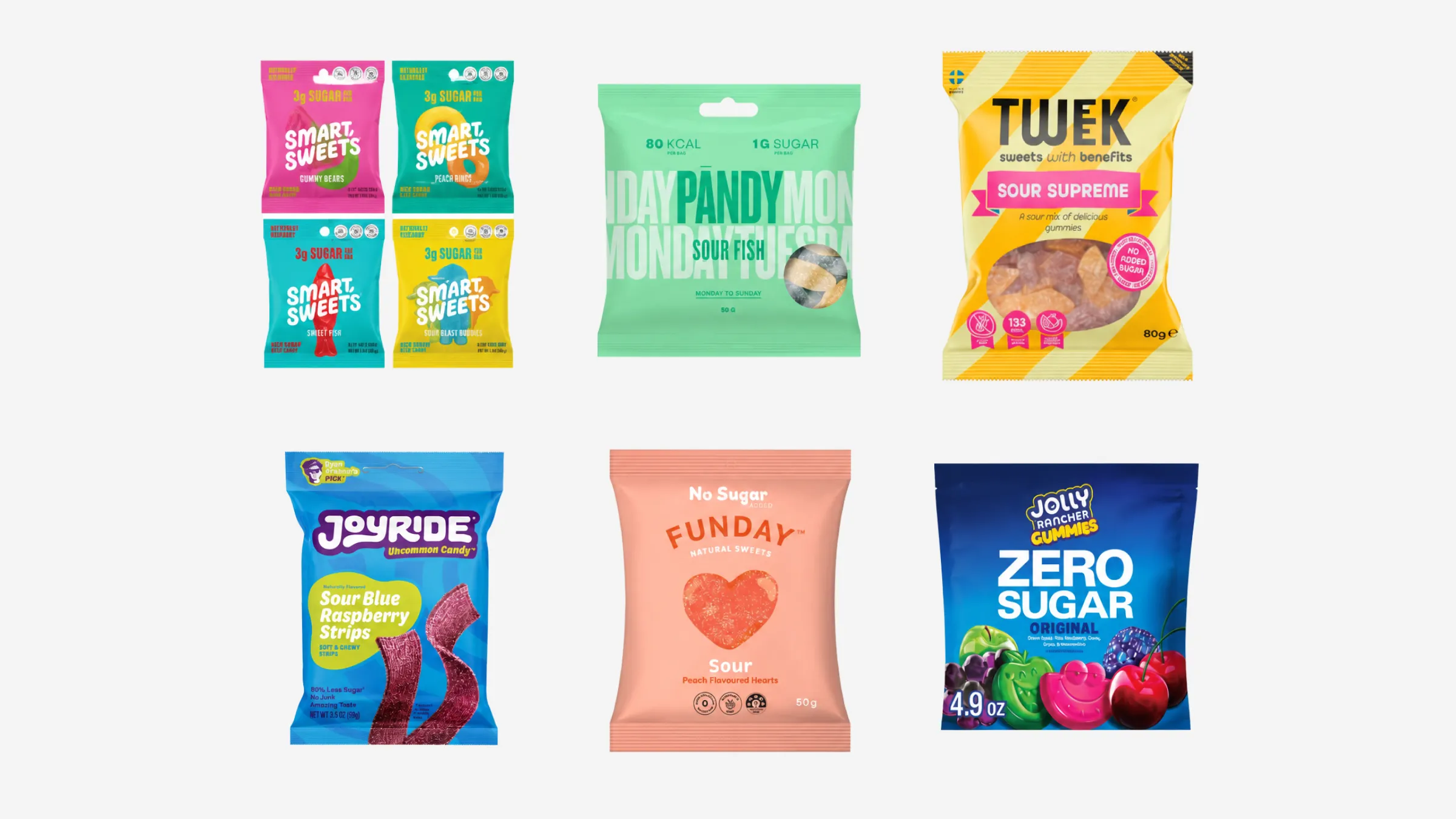
Fiber-based systems with no sugar alcohols are one. SmartSweets built its line on isomaltooligosaccharides, chicory root fiber, modified starch, pectin, and stevia, explicitly avoiding sugar alcohols as fillers, with products like Sweet Fish and Peach Rings carrying about 3 g of sugar per 50 g bag (SmartSweets, Gummy Worms product details). FUNDAY in Australia and New Zealand works the same direction: its Sour Peach Hearts use tapioca-derived soluble fiber, chicory root fiber, gelatin, and stevia, and are marketed with no added sugar and no sugar alcohols (FUNDAY, product pages).
Sugar-alcohol-plus-fiber blends are a second pattern. Pändy of Sweden uses polydextrose, isomaltooligosaccharides, and erythritol behind a gelatin base, which keeps the classic sour-gelatin texture while bringing sugar down to roughly 1.3 g per 100 g (Pändy, Sour Fish ingredient list). Tweek, another Swedish brand, uses a similar blend plus modified potato starch and stevia, and its Very Vegan line runs without gelatin at all (Tweek, product pages). Jolly Rancher’s Zero Sugar Gummies, from Hershey, apply the blend logic at mainstream scale: 19 g mini packs list 0 g of sugar, built on polydextrose, maltitol, maltitol syrup, and modified corn starch (Hershey, Jolly Rancher Zero Sugar product line).
Reduced-sugar formulas are the third pattern. JOYRIDE’s Sour Blue Raspberry Strips claim about 80% less sugar than the leading comparable product, built on soluble corn fiber, allulose, wheat flour, agar, glycerin, and sugar (JOYRIDE, product pages). Haribo’s Fruitilicious takes a different reduced route, sold explicitly as 30% less sugar (Haribo, Fruitilicious product information). These products keep some sugar and position around reduction rather than elimination, which is a different label and a different shopper.
Sweetener Systems and Taste Differences
Each pattern changes what the candy tastes like. Erythritol-based blends taste clean. Maltitol-based blends come closest to sucrose in flavor, though large amounts raise tolerance questions. Fiber-based systems without sugar alcohols read closest to conventional candy in texture, because the fiber does much of the structural work that sugar used to do.
For buyers evaluating samples, the practical check is to judge the piece against your target profile: where the sweetness peaks and how the finish reads. Those differences are settled at sampling, not by description.
For buyers, the pattern choice is a positioning decision as much as a recipe one. A fiber-based, no-sugar-alcohol line fits a clean-label or "natural" shelf story. A sugar-alcohol blend fits a price-led reduced-sugar range where texture familiarity matters most. A reduced-sugar formula fits brands whose buyers want the classic taste with less sugar, and it needs a comparison basis on the label. Choosing the pattern first makes the rest of the brief much easier to write.
What Buyers Should Check Before Adding a Sugar-Free Line
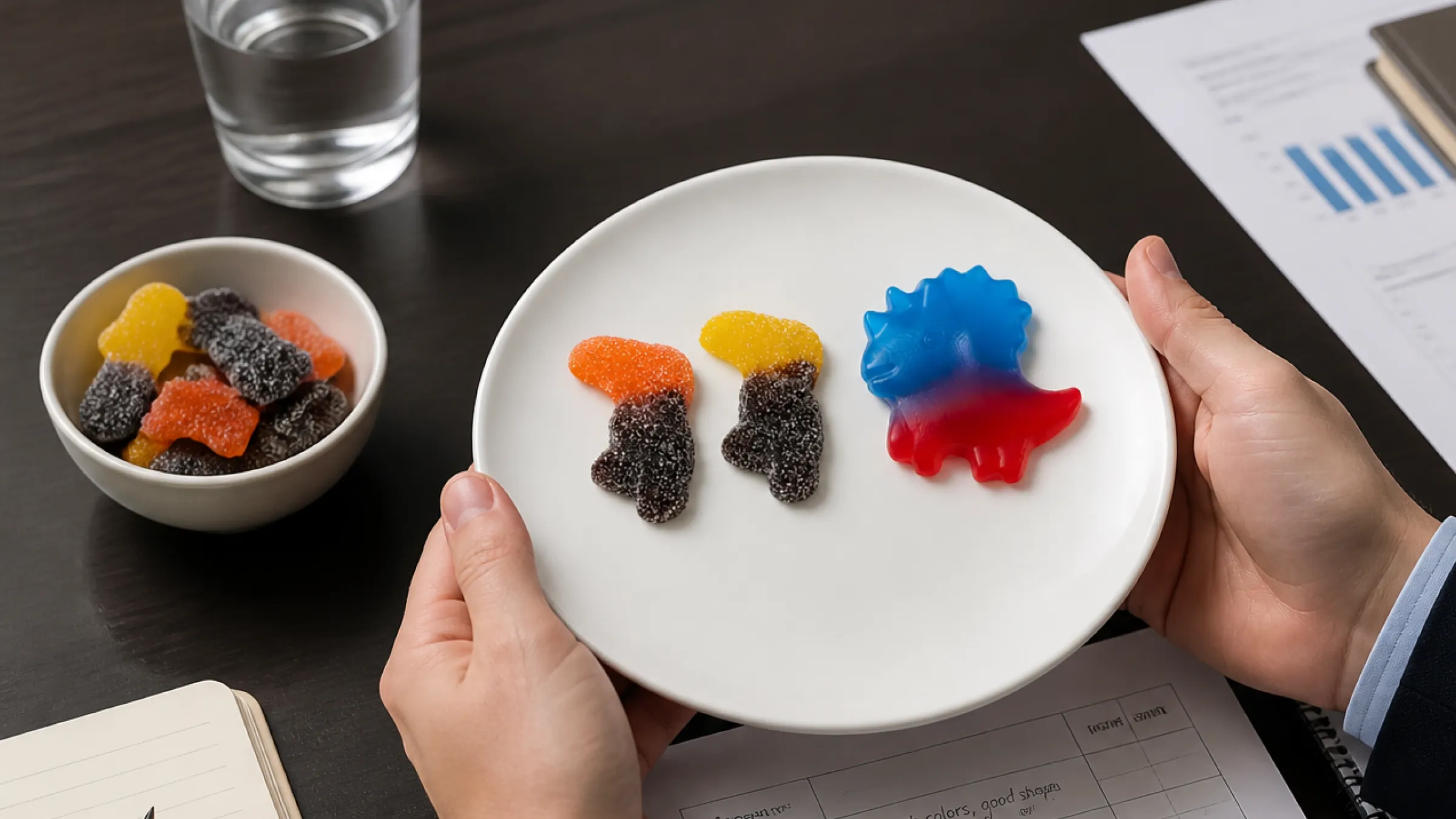
The formula is developed as its own recipe, not as a reduction of the standard one. Texture and sweetness are confirmed against a reference sample, and the approved sample becomes the production reference. Label claims are checked against the destination market’s rules before printing, including any mandatory statements the claim requires. And the cost structure is quoted separately from the standard range, because the ingredient system differs.
On the commercial side, MOQ follows the same structure as other programs: 2,000 kg per SKU.
How Sweeto Supports Sugar-Free Programs
Sweeto develops sugar-free gummies as their own recipes, with the sweetener system chosen against the buyer’s requirement and confirmed at sampling. Sugar-free versions are available for a wide part of the range, and feasibility is confirmed per item. Label work is handled in the same program as production, so claims and declarations match the destination market. Details start from our custom program and the sugar-free gummy range.
If you are planning a sugar-free line, send us your target market and a reference sample. We will prepare comparison samples and confirm the formula and label requirements for your market.
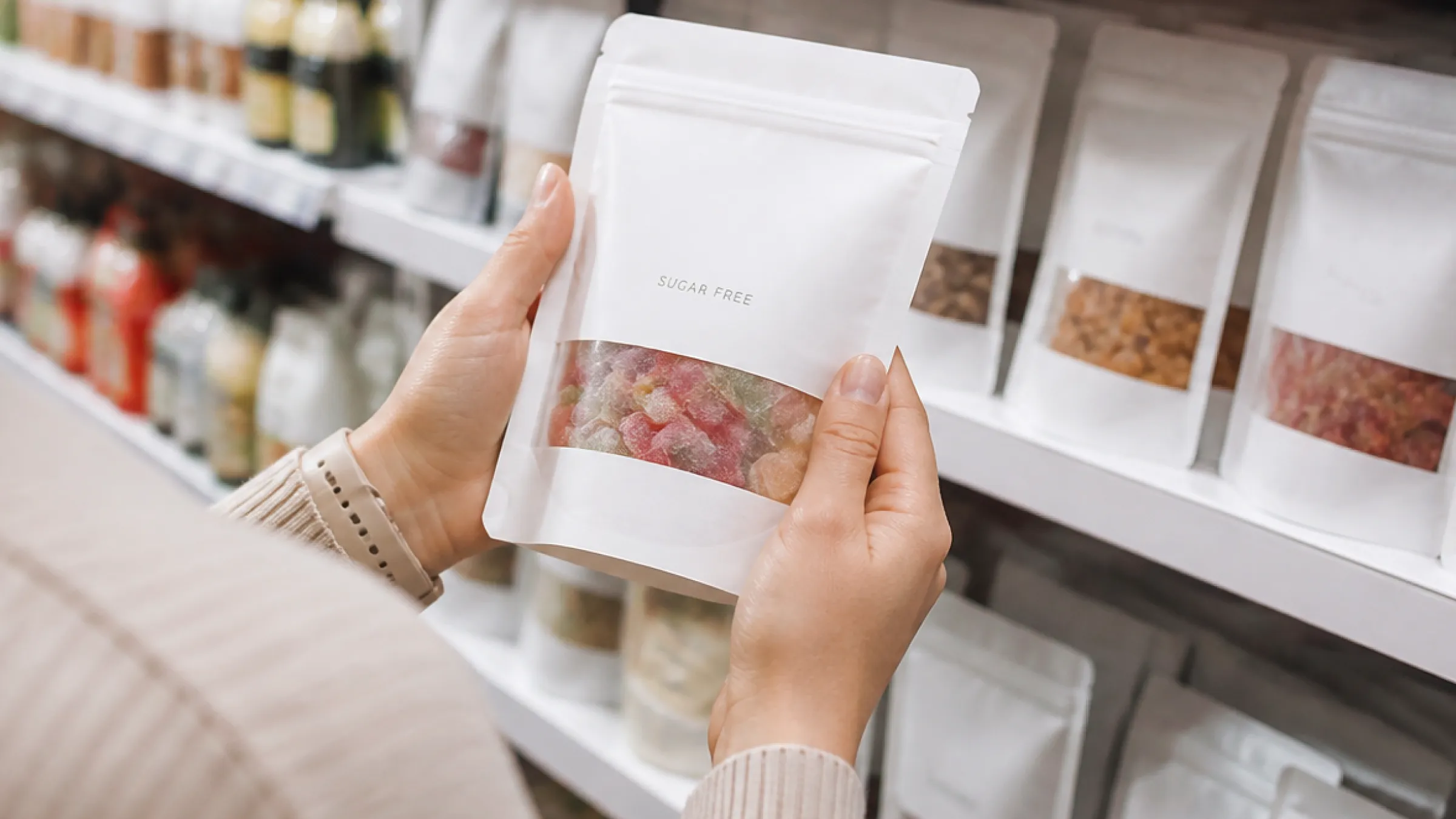
Three drivers show up together: sugar taxes and reformulation pressure in dozens of countries, a large base of consumers watching sugar intake, and brands bringing sugar-free products into mainstream retail rather than treating them as a niche. Market researchers put the category at about USD 2.5 billion with growth roughly twice the rate of conventional candy.