Easter Gummies: What Buyers Stock for the Spring Season, and When to Order It
The Halloween season is still underway. If you are planning beyond it, the next date to plan around is Easter: the second-biggest holiday for candy purchasing in the United States, behind Halloween (Numerator, Easter candy sales data via NACS). NCA’s 2026 Easter research puts the season at USD 5.6 billion in retail sales for 2025, with 92% of Americans who celebrate Easter including chocolate and candy in it (NCA, Easter research).
Easter differs from Halloween in one practical way that shapes the whole program: its date moves every year, so the calendar cannot simply be reused. This article covers the shape assortment for spring, the pack formats that fit each occasion, and the ordering window that runs backwards from a moving date.
The Order Window for a Date That Moves
Many retailers start their Easter set right after Valentine’s Day, which makes mid-February the working shelf date for planning. From there, the chain runs backwards through production and shipping. For 2027, Easter Sunday falls on March 28, and Chinese New Year falls on February 17. Production and dispatch need to clear the pre-holiday logistics slowdown, which makes the factory conversation an autumn task rather than a winter one.
| Milestone | Planning frame |
| Product selection and brief | September to October |
| Sampling and sign-off | October to November |
| Production | November to December |
| Ocean freight and customs | Dispatch completed by early January |
| In-store set | Right after Valentine’s Day |
The frame is a planning guide, not a fixed schedule: each program runs on its own cycle, and reorders of known products compress much shorter than first-time developments. The point of laying it out is that an Easter program decided in January is already late, because the production and shipping window sits on top of the Chinese New Year slowdown.
Two details inside that window deserve a note. Sampling rounds take time: a seasonal program usually wants a physical sample approved before production is booked, and each round adds days. Production is also scheduled in seasonal blocks, so factories fill Halloween and Easter capacity on a first-confirmed, first-scheduled basis. Buyers who sign off samples early get the early production slots.
The Shape Mix for Spring
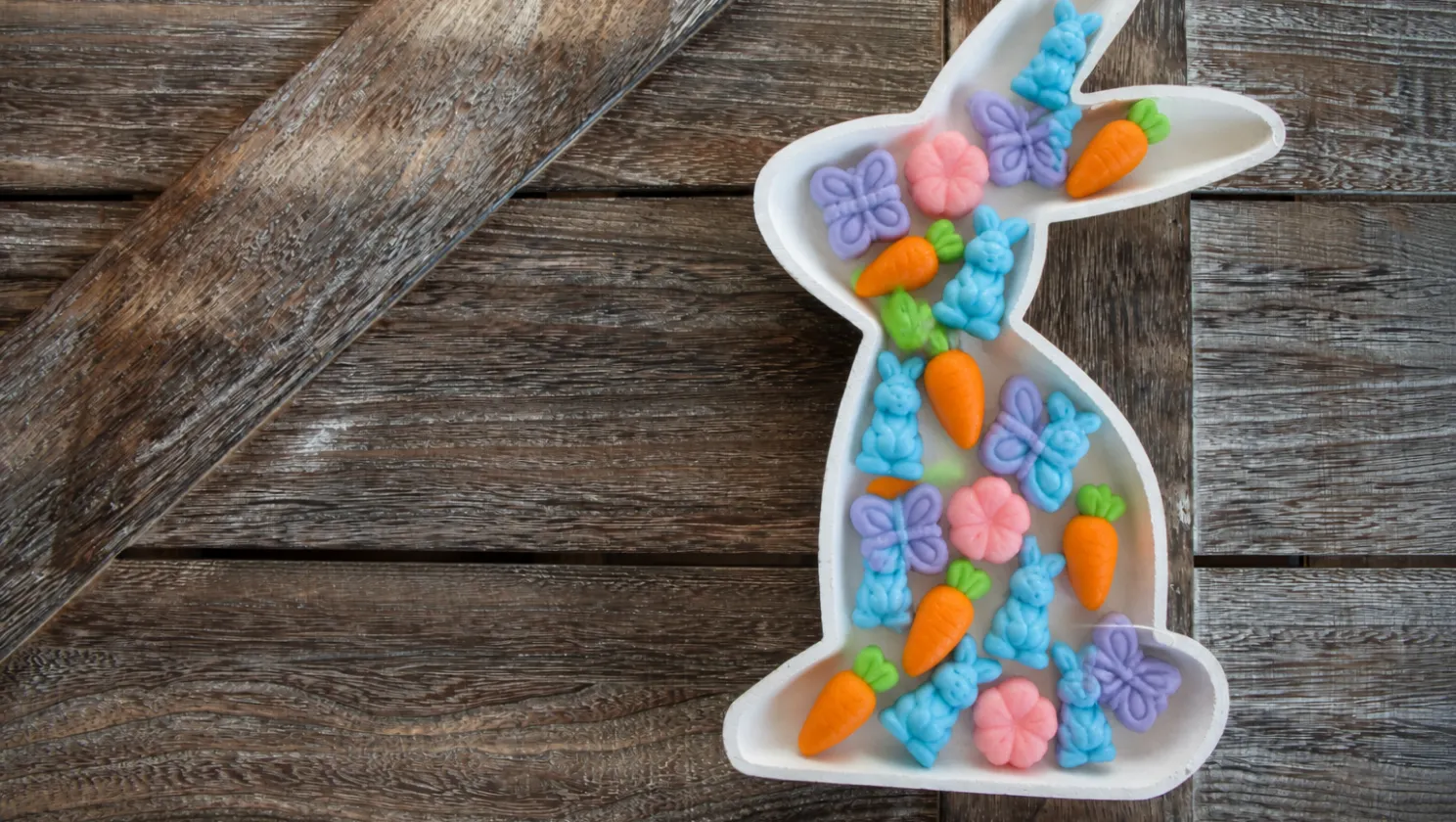
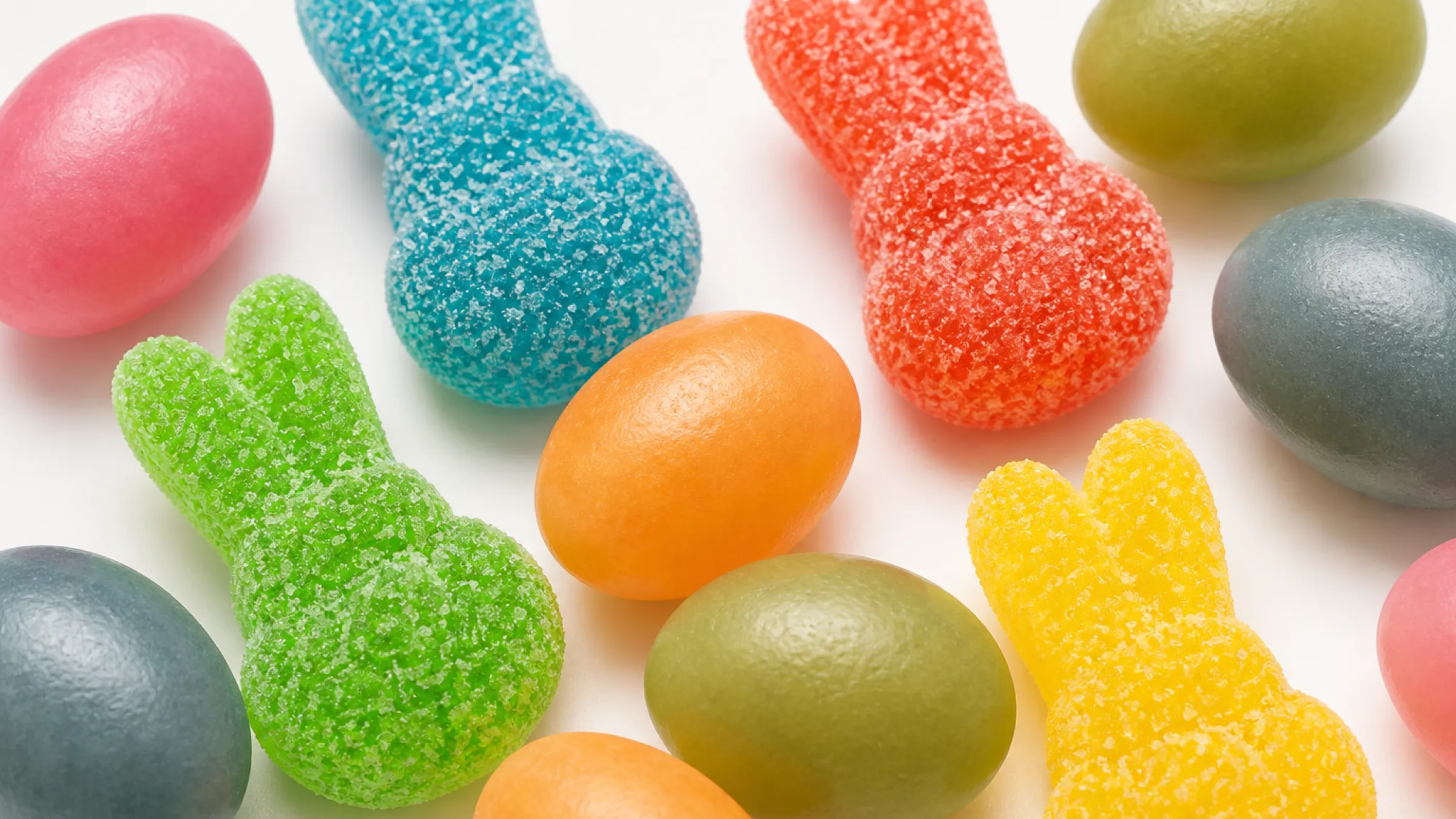
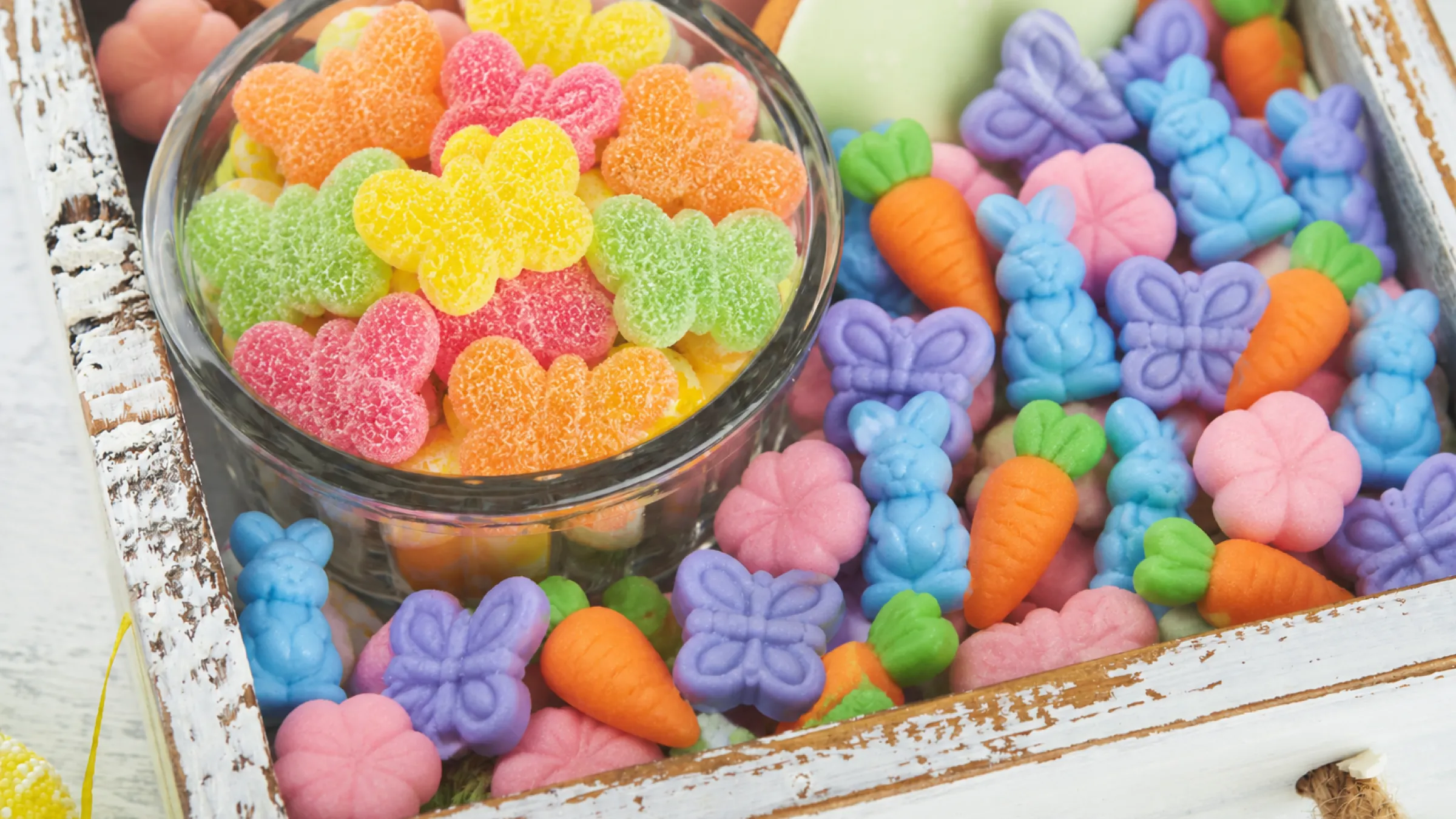
The spring assortment is built on a small set of shapes. Easter eggs carry the category’s recognition, and the decisions run across build, colour, coating, and how the shapes sit together in a pack, not just single-colour versus two-tone. Bunny pieces lead the character side, with size and coating choices confirmed at sampling. Carrots, butterflies, and flowers extend the same program through spring, so one production run covers both the Easter moment and the longer spring shelf.
The coating choice changes how these pieces eat: oiled builds keep colour glossy and flavour direct, while sugar-sanded builds add a crystalline first note and a sour option. Sour levels are adjusted against a reference sample, which is how a standard egg or bunny becomes a sour Easter variant without any change to the mould.
Two-tone eggs deserve a separate note because the layer boundary is visible on the finished piece. Buyers can check the split directly on a sample: the coloured half should read as a distinct layer over the pale half, with a clean boundary along the egg. This is the kind of detail that is easy to verify on a physical sample and hard to judge from a product photo.
Brand practice gives a useful reference for composing the mix. Haribo’s 2025 spring line kept its classic Goldbears in Easter formats such as treat-size bags and candy tubes, while building separate seasonal shape lines: Happy Chicks for egg-and-chick pieces, Happy Hoppers for bunny-and-carrot pieces, Sour Easter Grass for sour formats, and a Spring Mix that combines classic and seasonal pieces in snack-size pouches (National Confectioners Association, Haribo reveals 2025 spring line). The structure is a standard one for buyers: a classic item in seasonal packaging for recognition, seasonal shapes for novelty, and a mixed pack to cover both.
One detail in the Haribo structure is worth copying: the mixed pack is where the two shape families meet. A Spring Mix pouch can carry a classic bear next to an Easter-shaped piece, so the shopper gets recognition and novelty in one bag. Buyers planning their first Easter program can use the same logic: anchor the mix with a shape customers already know, and let one or two seasonal shapes carry the seasonal story.
Pack Formats for the Season
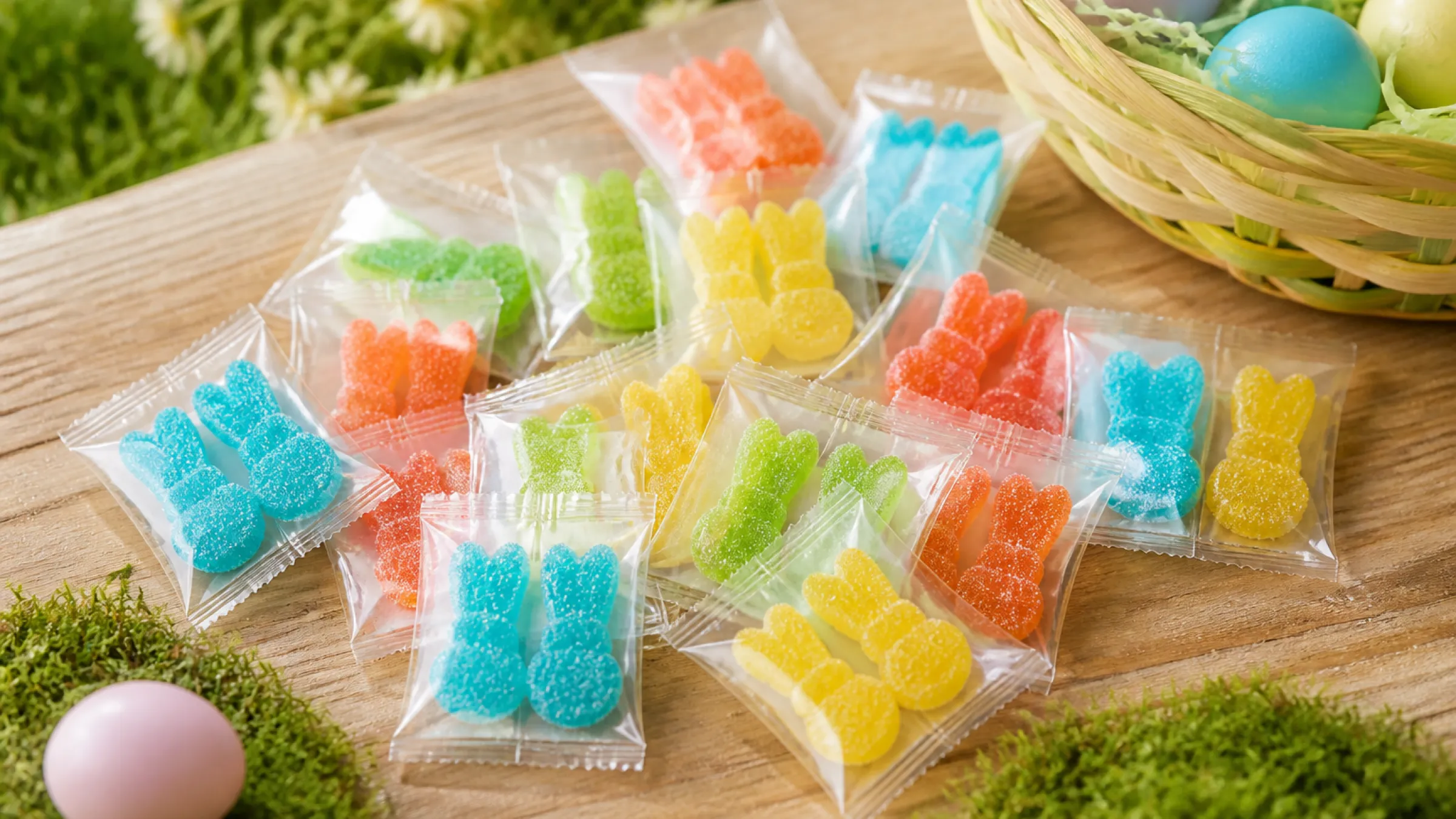
Three pack formats are commonly specified for spring programs. Individually wrapped mini packs serve egg-hunt occasions, and the format choice is documented as a purchase driver: NCA’s 2019 Easter research found that 85% of parents said individually wrapped or fun-size options influenced their seasonal candy purchases (NCA, Easter research).
Bulk bags serve candy shops and pick-and-mix programs. Shelf-ready cases serve retail programs where labor matters: the outer case tears open and goes straight onto the shelf, so store staff skip unpacking and restocking individual units. Each format answers a different occasion, and the order structure usually splits by occasion rather than by shape.
For egg-hunt formats, two numbers get set during the packaging specification: the number of pieces per sachet and the number of sachets per outer bag. Those two figures decide how the pack reads on the shelf and how it fits the occasion, so they belong in the written specification alongside the artwork.
How Sweeto Supports Easter Programs
Our catalogue covers the spring shape set: eggs, bunnies, carrots, butterflies, and flowers, with pastel colour programs and two-tone builds specified per project. Our Easter range covers all of these shapes.. Seasonal orders run in scheduled production blocks, and Easter programs are planned against the Chinese New Year calendar so production and dispatch clear the holiday slowdown.
Buyers with a shape idea beyond the current range can develop it with us through our custom program. If you are planning for the spring season, send us your channel and target market, and we will come back with a shape mix and a planning timeline for your program. Standard terms are listed on our wholesale page.
As a planning frame, product selection in September to October, sampling in October to November, production in November to December, and dispatch by early January puts the set on shelves right after Valentine’s Day. Each program runs on its own cycle, and reorders of known products compress much shorter. The reason to start early is that Easter production and shipping overlap with the Chinese New Year slowdown.