Best Gummy Candy Suppliers: How to Evaluate Gummy Candy Companies Before You Buy
Who Makes Gummy Candy? How the Supply Chain Is Structured
The brand on the package is often not the company that made the product. A large share of the gummy candy on retail shelves is produced by contract manufacturers or private label factories, while the brand owner handles marketing and distribution. This applies across product types, from standard shapes to filled and peelable formats.
Three roles appear in most gummy supply chains:
Manufacturers own production lines, recipes, and quality systems. They develop formulas, control raw materials, and produce candy. Working directly with a manufacturer gives the buyer access to formulation decisions, process data, and production scheduling.
Trading companies generally source products from one or more factories and resell them to buyers. They add value through product variety, multilingual communication, order consolidation, and export handling. For buyers seeking very small volumes across a wide range of product types, a trader may also be a good fit.
Sourcing agents and brand owners sit at the two ends. Agents work on behalf of the buyer to find and audit suppliers. Brand owners design the product and either contract a manufacturer to produce it or partner with a trader to source it.
None of these roles is inherently better. The correct choice depends on order volume, product complexity, and how much control the buyer needs over the product itself.
Manufacturer vs Trader
The difference between a manufacturer and a trader is best understood across a few practical dimensions. Both have legitimate strengths.
Price structure. A manufacturer quotes factory pricing, with cost driven by raw materials, batch size, and packaging. A trader, on the other hand, incorporates the handling of supplier management, communication, and factory quality checks into their pricing. It is also worth noting that many manufacturers now run their own export and service teams, offering the same level of communication and support as a trader while removing one layer of dialogue between the buyer and the production line.
Quality control access. A manufacturer controls quality at the source: incoming raw materials, process parameters and drying, and final inspection sit under one system, and the buyer can audit them. A trader's quality control depends on factory selection and inspection effort, which varies from trader to trader. Some traders run pre-shipment inspections on every order, while others reduce inspection once a factory relationship stabilizes. Buyers working through traders should ask how quality is verified at the factory level, in addition to pre-shipment checks.
Product customization. Custom formulas, shapes, and specifications are decided at the production level, either by the manufacturer or together with the buyer. A manufacturer can adjust gelatin grade, moisture targets, flavor systems, and packaging directly, and buyers are welcome to take part in formula development based on their market requirements. A trader passes these requests to the factory, which adds communication steps and can limit what is negotiable.
Communication and service. Service quality is no longer tied to the trader model. Factory export teams have grown stronger in recent years, with faster response times and more complete support throughout the project, from specification discussions to shipment follow-up. Responsiveness is best tested directly during the sampling stage, regardless of which type of supplier you contact.
A practical summary: manufacturers give buyers direct control over the product, stable reorders, and direct access to production decisions, which is the foundation of a long-term supply relationship.
The Supplier Evaluation Checklist: Five Areas That Matter
Whether you are evaluating a manufacturer, trading company or sourcing partner, the following areas are worth examining before onboarding a supplier.
Certifications and Compliance
Food safety certification is the entry requirement. For gummy candy, the baseline is HACCP and ISO 22000, with FDA registration required for the United States. Halal and kosher certification matter for Middle East, Southeast Asian, and specific Western market segments, and buyers should confirm whether the certification scope covers the actual product line. European retail chains ask for BRCGS or IFS in many cases, so a supplier working toward these standards is worth noting. Certificates should name the manufacturing facility, and buyers should verify scope, certification body, and validity dates. The BRCGS scheme and its certificated-site directory are published at Brcgs.
Production Capacity and Consistency
Capacity determines whether a supplier can take your order without pushing out existing clients. Ask for the number of production lines, daily output, and how capacity is reserved for repeat customers. Consistency matters as much as volume: automated weighing and dosing systems keep recipe error very low, which is what batch-to-batch consistency looks like in practice. As an illustration from our own facility, three automated production lines produce roughly 60 tons of gummies per day.
MOQ and Order Flexibility
Minimum order quantity defines whether a supplier fits your current stage. MOQs in the gummy industry are set per SKU rather than per order, because production lines are configured per recipe. Our own standard, as a reference point, is 2,000 kg per SKU with 1,000 kg for a single color, and trial orders can be arranged at more flexible quantities.
Sampling and Development
The sampling stage is useful for assessing responsiveness, technical communication and how clearly the supplier translates a buyer brief into a production specification. In our production, stock samples are prepared and shipped without delay, and custom samples are produced after specifications are confirmed, with additional time required when a custom shape or new mold is involved. Sample fees are normal practice in the industry and are credited against the first bulk order.
Lead-Time Reliability
Ask for the standard lead time and the factors that extend it. In gummy production, drying is the bottleneck in many factories, and factories with more drying capacity deliver more reliably. Flexibility matters here: a factory that controls its own scheduling can accelerate urgent projects when capacity allows, which is a structural advantage over any intermediary that must negotiate production slots with a third party.
Factory Audits and Third-Party Inspection: What to Examine
An on-site audit is the most direct way to verify a gummy supplier, and video audits are an accepted alternative when travel is impractical. Third-party inspection agencies such as SGS, Intertek, or Bureau Veritas can perform facility audits and pre-shipment inspections on the buyer's behalf. The checkpoints below reflect what experienced buyers examine in a gummy factory. The scope of third-party food facility audits is described at intertek.
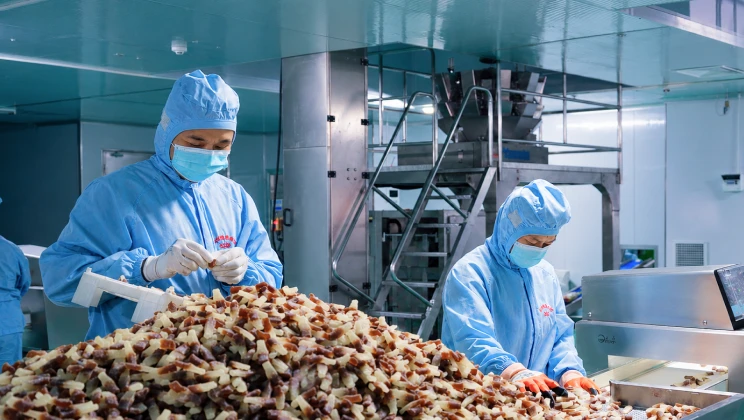
Hygiene and personnel control. Entry procedures tell much of the story: changing rooms, hand washing and disinfection, air showers, and full hair coverage are baseline requirements under HACCP. The unpacking area deserves attention as well, since cartons, straps, and bags are common sources of foreign material, and professional facilities remove outer packaging before materials enter production zones.
Foreign material controls. Ask how the factory prevents and detects foreign material. Metal detection on every finished line is the expected final barrier, and the factory should describe how alarms are handled and recorded.
Process control evidence. Look at how recipes are executed. Automated dosing, documented cooking parameters, Bloom grade records, moisture analyzer results, and curing or drying logs indicate a controlled process. A factory should be able to show these records for a recent batch.
Drying efficiency and conditions. Because drying is often the bottleneck in gummy production, evaluate how the drying rooms are engineered rather than just counting them. Advanced drying rooms utilize full-face air supply, full-face air return, and top-circulation dehumidification. This design minimizes drying dead zones, improves drying uniformity within the same room, and increases overall efficiency, which is the true foundation for stable lead times.
Documentation and traceability. Request a certificate of analysis for a recent batch, ask how long full traceability takes, and check whether mock recalls have been performed. Third-party laboratory reports carry more weight than in-house results alone. Water activity data, requested by more European and North American buyers each year, should be available through third-party testing.
Specification sheets. The product specification sheet is the working quality document between buyer and factory. It records the approved product specification and agreed formulation requirements, moisture target, packaging, testing items, and tolerances for each SKU, and both sides confirm it before production. The process runs from the buyer's template or the factory's template, through sample validation, to mass production. A factory that keeps specification sheets on file for every SKU can reproduce your product on reorder without a new discussion each time.
Mold and tooling library. A factory's mold library indicates its range of production-ready shapes. While a large library means many standard shapes can start without new tooling costs or delays, custom designs will typically require new molds, which incurs additional fees and lead time.
How We Work as a Gummy Manufacturer
The evaluation criteria above describe how we operate, and buyers are welcome to test us against them.
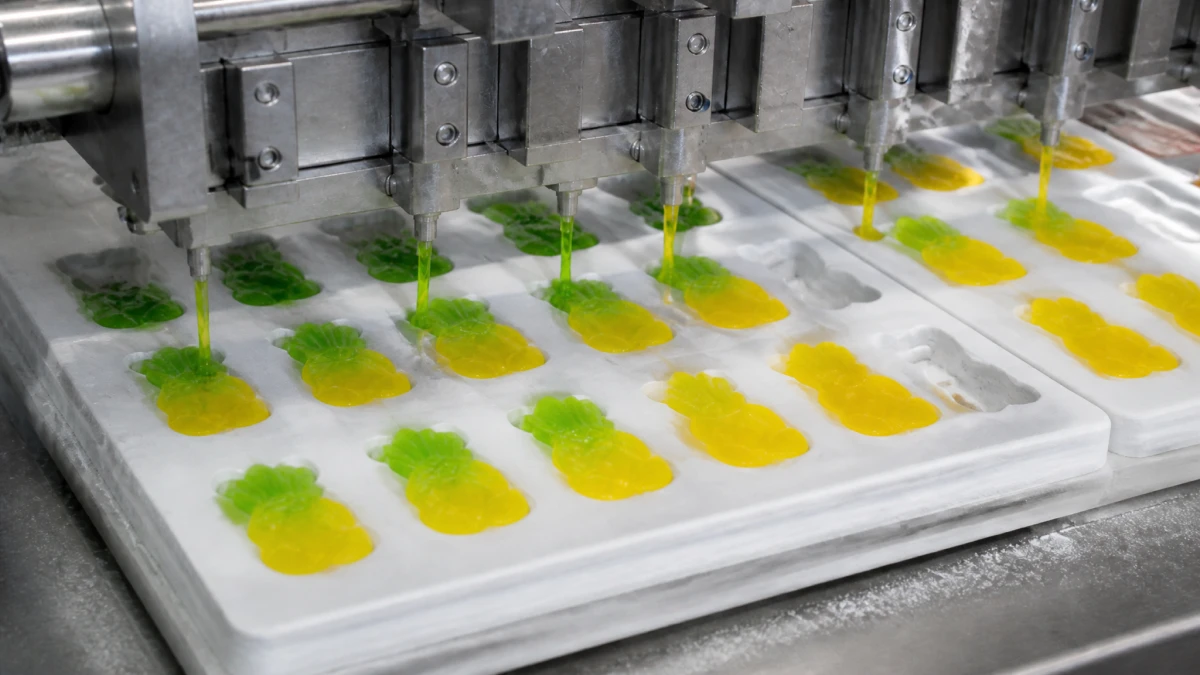
Production and capacity. We run three production lines with a daily capacity of roughly 60 tons, covering gelatin, pectin, starch, and carrageenan systems, as well as solid, aerated, filled, peelable, and freeze-dried formats. Automated dosing keeps formulation deviation very low, and 28 drying rooms with dual cold and hot drying modes keep drying time below the industry norm, which is the main reason our lead times hold.
Sampling and development. Stock samples ship within 7 to 15 days, sample fees are credited against the bulk order, and custom shapes require one additional week for mold work. Our in-house formulators support OEM and ODM development from formula to packaging, including sugar-free, halal, vegan, and pectin-based recipes.
Quality system and certification. The factory operates under HACCP and ISO 22000 with FDA registration, and halal and kosher production is supported within certification scope, including validated cleaning between certified runs. Metal detection runs on every finished line, and third-party testing can be arranged at the customer's request.
Audits and inspection. Factory visits and video audits are welcome, and third-party inspection is supported for any order. Batch documentation, moisture and Brix data, and traceability records are part of the standard working process.
Order terms. Standard MOQ is 2,000 kg per SKU with flexible trial arrangements, Standard products may have shorter preparation times depending on product and packaging availability. OEM and Private Label orders carry a lead time of 30–45 days after order confirmation, and ODM projects take 30–45 days after formula and artwork confirmation.
Buyers who want to test these claims can start with a sample order. Our custom gummy program handles development projects from brief to production, and standard terms are listed on the wholesale page. An overview of our lines, quality systems, and export markets is available on the capabilities page.
Conclusion
The search for the best gummy candy supplier is mostly a verification exercise. The supply chain contains capable manufacturers, useful traders, and businesses that are difficult to classify, and the buyer's task is to identify which role a candidate actually plays and whether its controls match the product's requirements. Certification scope, capacity, MOQ, sampling behavior, lead time stability, and audit transparency answer that question more reliably than any quotation.
Price comparisons become meaningful after these checks, because a price without a specification and a quality system behind it cannot be compared with one that has both. Buyers who run this process once can reuse the checklist for every future supplier, and the time spent on verification is small next to the cost of a failed first container.
In many cases, the brand on the package is not the direct manufacturer. A large share of gummy candy on retail shelves is produced by specialized contract manufacturers and private label factories, while brand owners focus primarily on branding, marketing, and distribution. This co-manufacturing model is standard practice across the candy industry for classic formats like bears, worms, and rings, as well as advanced filled and peelable products.