Private Label Gummies: How the Process Works From Brief to Reorder
A private label gummy is a product made by a manufacturer and sold under the buyer’s brand. The buyer owns the brand, the pack, and the label; the factory develops and produces the product behind them. In most programs the pack does not name the manufacturer at all, so to the consumer the product belongs entirely to the brand on the bag.
What the Buyer Owns and What the Factory Does
A private label program is a shared effort between the buyer and the manufacturer. The product-related work is handled jointly: the buyer brings the brand requirements, the target market, and the product brief, and the factory works with the buyer on the recipe, the packaging design, and the label content, including coordinating packaging suppliers where the buyer needs that support. The Private Label Manufacturers Association defines private label products as merchandise sold under the buyer’s own brand, and that brand ownership is what defines the model (PLMA, About PLMA).
The product itself is defined per program. Some programs select existing products from the factory’s range. Others need a product that does not exist yet, with its own recipe, shape, flavour, or packaging, and the factory develops it for that buyer. Either way, the finished product ships under the buyer’s brand, and the manufacturing relationship stays in the background. What matters at the start is that the product scope is written down clearly, because everything after that point follows from it.
Who Private Label Programs Are For
Three kinds of buyers run most private label gummy programs. New brands use the model to put a first assortment on the market without building production. Retail chains use it for store-brand candy lines, where the retailer’s name is the brand. And established brands use it to extend a range into gummies when candy is outside their own production. The process is the same for all three; what changes is the product scope and the volume.
The Process Step by Step
A private label gummy program runs in six steps. At each step the factory works with the buyer and offers concrete suggestions, because the details are settled through discussion rather than handed over. The table summarizes how that cooperation looks in practice.
| Step | How the factory works with the buyer at this step |
| Brief | Discusses the product, target market, and channel with the buyer, and proposes products or a development route against the brief |
| Formula confirmation | Confirms flavour, colour, and coating options together with the buyer, and advises on certification needs such as halal. |
| Packaging and label | Executes the pack format and label printing, advises on formats, and can coordinate packaging suppliers for the buyer |
| Compliance check | Confirms certification scope and production documentation, and reviews the label content with the buyer |
| Sampling and sign-off | Produces the pre-production sample and records it as the production reference after the buyer approves it |
| Production and reorder | Produces and reproduces against the recorded specification agreed with the buyer |
Two steps are worth early attention, because they are easier to settle before production than after it. At formula confirmation, certification requirements are best raised before anything is printed: a halal or sugar-free requirement can change the recipe or the production conditions, and both are easier to accommodate at this step than after sampling. At packaging and label, the label content includes the ingredient declaration, allergen information, net weight, and any market-required language versions, and approving the artwork before printing saves rework later.
The brief itself deserves a sentence, because the quality of the first step decides the speed of all the others. A useful brief covers the target market, the sales channel, the intended price point, the expected volume, and any certification the market requires. With those five points on the table, the factory can answer with a concrete product proposal instead of a catalogue dump.
Sampling closes the loop. The signed-off physical sample becomes the fixed point of the program: production batches are checked against it, and reorders are produced against the recorded specification. A buyer who keeps a reference sample from each delivery can verify the product directly instead of relying on descriptions.
What to Put in Writing Before the First Order
Five items should be settled in writing before production starts. The trademark and label content are the buyer’s legal responsibility, including compliance with the target market’s rules. The product specification is recorded, so both sides know exactly what "the product" means. Certification scope is confirmed explicitly: whether the factory’s certificates cover production under the buyer’s brand depends on the certifying body’s rules, and this should be checked rather than assumed. Any exclusivity arrangement, for a product, a shape, or a region, is negotiated and written down. And the ownership of packaging files and printing plates is agreed, so the buyer knows where their artwork assets live if the program ever moves.
One more item is specific to private label: confidentiality. Since the pack typically does not name the manufacturer, both sides usually agree on how the relationship is handled in documentation and communication. This is standard practice in the industry, and it is worth stating in the agreement rather than leaving it to habit.
Artwork and packaging assets are the other practical point. Labels, printed films, and plates are produced against the buyer’s brand, and the agreement should state who owns them and where they are stored, so a reorder never waits for a file that lives in someone’s inbox.
How Sweeto Supports Private Label Programs
Sweeto produces private label gummies for brand owners and retail programs, and the manufacturing relationship stays behind the buyer’s brand. Programs can start from our wide range of proven gummy products or from a buyer’s own product requirement, with recipe, shape, flavour, and packaging defined per program. Colour, flavour, and coating adjustments are confirmed during development, and certification needs such as halal production are handled inside the same project.
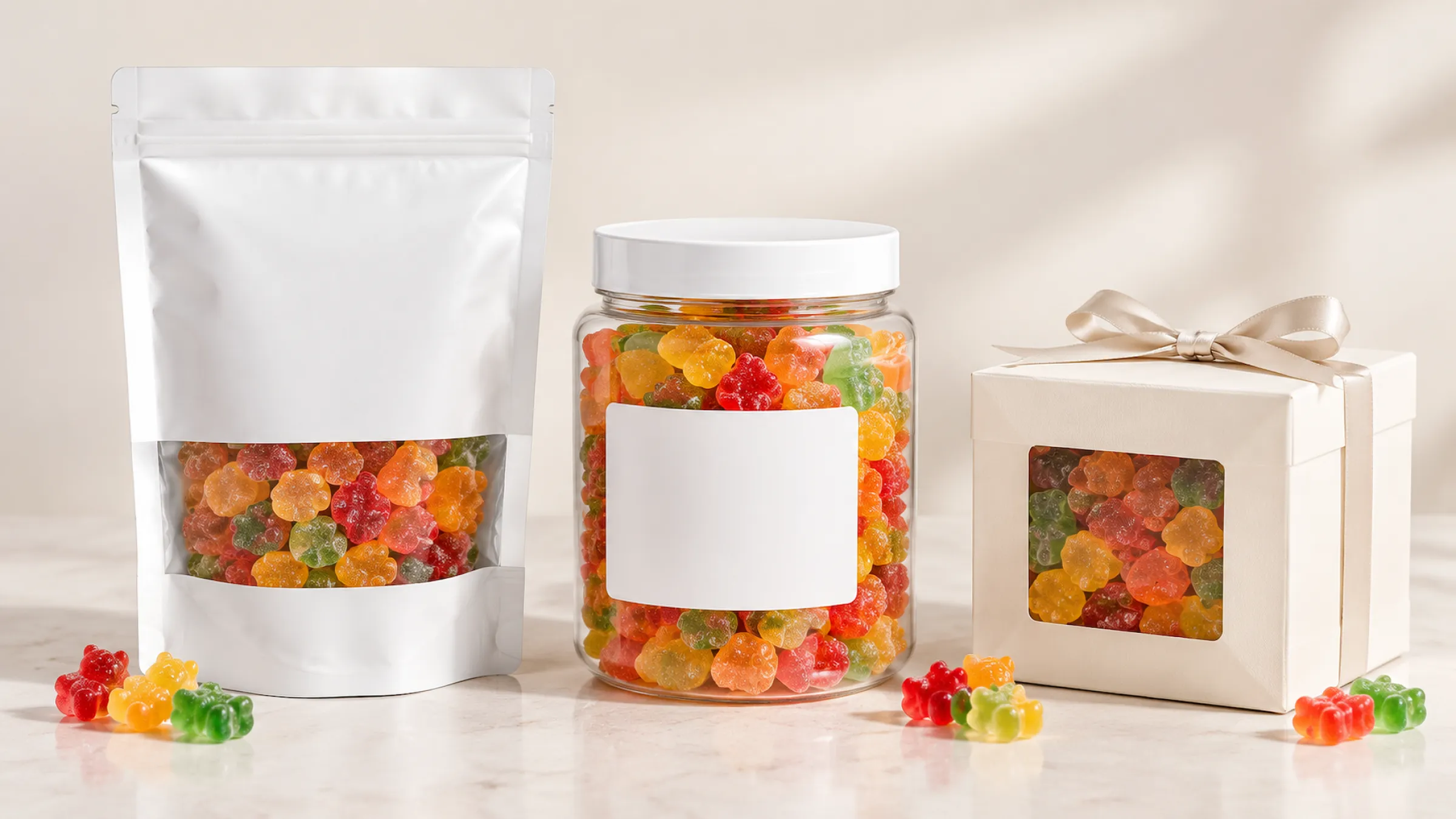
Packaging and label work run inside the same program as production: pack formats from pouches to jars and gift boxes, printed labels, barcodes, and market-language versions are handled together, so the pack that ships matches the signed-off sample. Standard commercial terms are listed on our wholesale gummies page, and an overview of our production and quality systems is on the capabilities page.
If you are planning a private label gummy program, send us your product brief, your target market, and your packaging requirements. We can propose products or a development route, arrange samples for evaluation, and confirm the certification scope for your program.
A private label gummy is produced by a manufacturer and sold under the buyer’s brand. The buyer owns the brand, the packaging, and the label, and the pack typically does not name the manufacturer. The term covers both brand owners commissioning production and retail chains building their own-label candy lines.